


SEO or Google Ads: where should your next marketing dollar go?
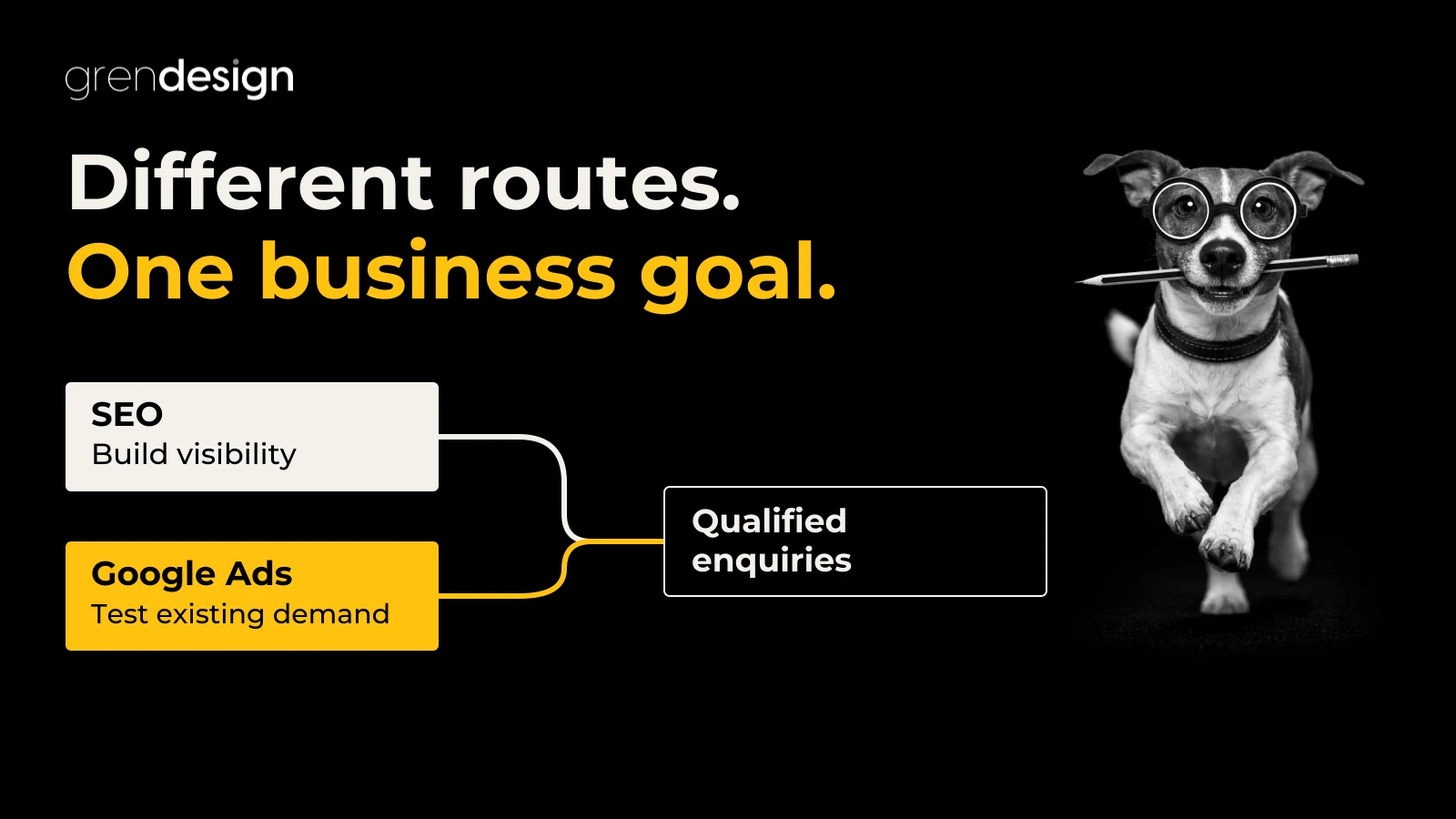
If you need to test an established service offer against existing search demand, Google Search ads can give you a more immediate way to put that offer in front of potential customers. If you need stronger organic visibility for services you’ll keep selling, SEO can build useful coverage over time. Neither choice guarantees enquiries, and neither fixes an unclear offer or an enquiry process that loses people after they make contact.
Put the advice into practice
Ongoing SEO, with a clear job to do
Find the search gaps, improve the right pages and review what produces useful enquiries.
Plan your search prioritiesThe best starting point is the commercial problem you need to solve. Are you trying to fill available capacity, become easier to find for an important service, or improve the quality of enquiries you’re already receiving? Those are different jobs. They may need different allocations of the same budget.
This guide compares SEO with Google Search advertising for service-led businesses. Other Google Ads formats have different uses and shouldn’t be treated as identical to search campaigns.
Six questions before choosing a channel
- How urgent is the need? A near-term gap in bookings calls for a different plan from strengthening discovery for next year’s growth. SEO shouldn’t be sold as an immediate replacement for a time-sensitive campaign.
- Is there relevant search demand? Look at the language customers use and the results those searches return. If people don’t yet recognise the problem or service category, search alone may not create the demand you need.
- What is a suitable new customer worth? Use contribution after delivery costs, not just headline revenue. Consider the sales cycle, capacity and the uncertainty of repeat work.
- Can the website support the decision? The page needs to explain the offer, fit, evidence and next step. A functioning form is necessary, but it doesn’t make the whole journey persuasive.
- What do you already have? Existing organic visibility, proven landing pages, past campaign information and sales feedback can all change where the next increment of budget is most useful.
- Who will do the ongoing work? Both channels need attention. Identify who approves content, fixes website problems, manages campaigns and reports on enquiry quality.
Write down the answers before asking for a percentage split. A business with a proven service and available capacity has a different starting position from one testing a new offer with little evidence of demand.
Compare what SEO and Google Ads actually need
| Decision factor | SEO | Google Search ads |
|---|---|---|
| Timing | Changes need to be discovered and assessed by search systems; impact varies | Can test an offer once the campaign is ready and eligible to run; useful results still require enough evidence |
| Control | You control your website work, not rankings or search-result presentation | You set campaign parameters and budgets, but do not control every auction or guarantee placement |
| Costs | Planning, content, technical work and ongoing maintenance | Media spend plus management, creative, landing pages and measurement work |
| Website requirement | Accessible, useful pages that answer relevant searches | A relevant destination that follows through on the ad and supports an enquiry |
| Ongoing work | Improve useful coverage, resolve problems and keep information accurate | Review traffic quality, search terms, exclusions, messaging and lead outcomes |
| Useful learning | Which questions and pages attract relevant organic visits | How selected offers and messages perform with paid search traffic |
Google explains that SEO changes can take different amounts of time to show an effect and that there is no guarantee of a particular search position in its SEO Starter Guide. That makes a fixed promise of rankings by a particular month a poor basis for allocating your budget.
SEO isn’t free simply because you don’t pay for each organic click. Paid search isn’t a finished system simply because an ad can run. In both cases, the work surrounding the click influences whether the business gets a useful opportunity.
Agree what counts as a useful enquiry
Before increasing either budget, define the stages you need to measure. For a service business, these might be:
- Enquiry: a genuine request from a person, excluding spam and duplicate submissions.
- Qualified enquiry: a request that matches your service, location and agreed commercial criteria.
- Sales opportunity: a suitable prospect with a confirmed next step in the buying process.
- Won customer: a sale recorded using the business’s agreed definition.
Keep the definitions workable for the people using them. If sales and marketing disagree on whether a lead is qualified, resolve that before comparing channel reports.
Google Analytics supports separate lead stages through events including generate_lead, qualify_lead and close_convert_lead. These populate different measures in its lead acquisition report. They require valid implementation. Naming an event doesn’t prove that a lead was suitable or a sale occurred.
Test a real enquiry journey with your team. Confirm that the form reaches the right person, the record isn’t duplicated and the source information is useful. Where phone enquiries matter, include them in the measurement plan. Record known gaps rather than quietly treating missing data as zero.
For longer sales cycles, connect the enquiry date with later outcomes where your systems and privacy requirements allow. Otherwise, you might compare a mature group of organic leads with a paid campaign whose prospects haven’t had time to decide.
Compare qualified enquiries, not cheap clicks
A low cost per click is helpful only if those visitors can become worthwhile customers. Start with two practical calculations:
- Cost per qualified enquiry: the relevant marketing cost divided by the number of qualified enquiries attributed under your agreed method.
- Acquisition cost: the relevant acquisition cost divided by the number of new customers won from that activity.
Define which costs are included before comparing results. If you include management and landing-page costs for Google Ads but exclude writing and technical work for SEO, the comparison is distorted. Keep shared costs visible and document how you allocate them. For a full customer-acquisition calculation, sales costs may also matter.
| Measure | Example A | Example B |
|---|---|---|
| Allocated marketing cost | A$4,800 | A$4,800 |
| Genuine enquiries | 24 | 16 |
| Qualified enquiries | 6 | 8 |
| Cost per qualified enquiry | A$800 | A$600 |
| New customers after the agreed sales window | 2 | 2 |
| Marketing cost per acquired customer | A$2,400 | A$2,400 |
Example A produces more enquiries. Example B produces more qualified enquiries. Both have the same marketing cost per acquired customer in this fictional comparison. The next question is whether those customers have comparable delivery costs, value and retention, not which report has the larger enquiry total.
These small numbers also warrant caution. One additional sale would change the calculation substantially. Treat early results as evidence to investigate, rather than proof that one channel will always outperform another.
Three situations that call for different decisions
You have capacity to fill and a proven offer
A focused paid-search test may be a sensible starting point if people already search for the service, the landing page is credible and sales can respond. Select one offer and relevant service area rather than spreading a limited budget across every service.
Agree the total test budget, what a suitable enquiry looks like and the conditions for pausing. For example, broken tracking or a surge in clearly irrelevant enquiries should trigger investigation before additional spend. Allow for the time people need to enquire and buy when interpreting results.
You have an established service but weak organic coverage
SEO may deserve the next investment when important buying questions have no useful page, your service information is thin or technical problems obstruct discovery. Prioritise work connected to a commercially important service rather than publishing a large volume of loosely related articles.
Some improvements, such as clearer service information and a better enquiry journey, can support both organic and paid visitors. Plan these shared foundations once, while keeping channel-specific goals distinct.
You receive traffic but the enquiries don’t fit
First diagnose where the mismatch begins. Is the search intent wrong? Does the page imply a service you don’t offer? Is the service area unclear? Are enquiries genuinely unsuitable, or are good prospects receiving slow or inconsistent follow-up?
A larger acquisition budget may simply bring more people through the same problem. Our guide to traffic that doesn’t become useful enquiries covers the website side of that diagnosis in more detail.
Use a staged plan instead of an arbitrary split
You don’t need to choose one channel permanently. You do need enough focus to understand what you’re learning.
- Establish the baseline. Record current spend, relevant landing pages, enquiry quality, sales stages and known measurement gaps.
- Choose the priority. State the service, audience, business outcome and constraint the next investment will address.
- Fund a coherent scope. Allow for the page, measurement and follow-up work as well as channel delivery. Avoid dividing the budget so thinly that neither activity can answer a useful question.
- Set review points. Check implementation and traffic relevance early. Assess qualified enquiries and sales outcomes over a window suited to your volume and buying cycle.
- Decide what changes. Continue, refine, reduce or pause based on the evidence. Record why, so the next review has something to compare.
Paid-search learning can suggest questions to investigate in your organic content. Organic enquiries can reveal useful language and service needs to test in campaigns. Neither source should be treated as a perfect substitute for the other because the visitors, placements and measurement conditions can differ.
Frequently asked questions
Does paying for Google Ads improve SEO rankings?
No. Google states that paid-search investment does not affect organic rankings. The channels can inform a shared marketing plan, but advertising doesn’t buy an organic ranking advantage.
Can we stop SEO once Google Ads is working?
You can change your investment priorities, but the website still needs accurate information and technical care. Review what organic search contributes before removing work that supports relevant visits and enquiries.
Should a small budget be split equally?
There is no universally useful split. Fund the most important problem and the work needed to address it. A focused scope can teach you more than two under-resourced programmes.
Which channel gives the best return?
That depends on your offer, competition, existing website, costs and sales outcomes. Compare consistent definitions over a suitable period, and acknowledge where attribution or downstream sales data is incomplete.
Start with the decision your budget needs to support
Grendesign offers SEO support and paid advertising services. Bring the service you want to grow, your current enquiry picture and the constraints on your budget. That provides a useful basis for deciding what to improve first, what to test and what evidence should guide the next investment.
