


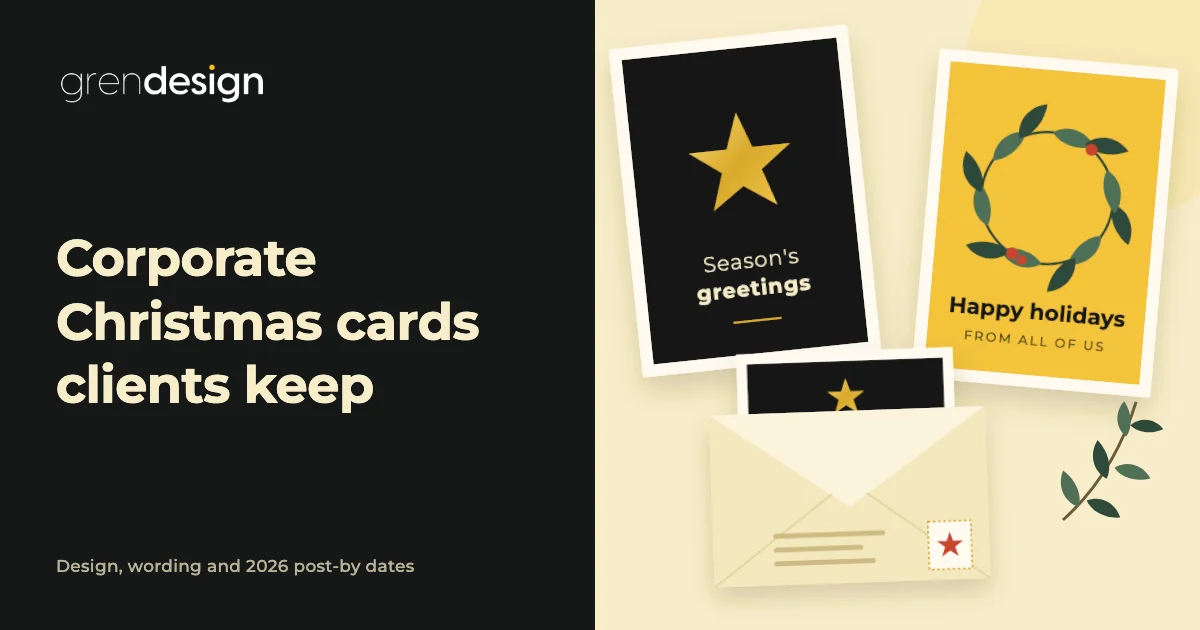
Corporate Christmas cards: design, wording and 2026 post-by dates
Corporate Christmas cards work best when they’re designed in your brand, written for the people you actually deal with, and posted on time. In 2026, Australia Post asks for cards to be posted by 18 December for interstate delivery and 21 December within the same state. Work backwards from those dates: brief, design, proof, print, sign and address.
Put the advice into practice
Make your expertise look as considered as the work behind it
Bring brand, sales material and digital design into one coherent presentation.
Discuss your design briefChristmas cards for your clients
Need custom company Christmas cards this year?
We design cards in your brand and supply print-ready files set up to your printer’s specifications, plus a matching e-card for clients you can’t post to.
Brief us on your Christmas cardsKey dates for business Christmas cards in 2026
Australia Post’s cut-offs for cards and letters sent between metro areas:
| Sending | Post by |
|---|---|
| Interstate | Friday 18 December 2026 |
| Within the same state | Monday 21 December 2026 |
| Overseas | Earlier, and it depends on the country and service. Some international cut-offs fall in late November and early December. |
Regional and rural addresses take longer, so post earlier for those. Check the latest dates on Australia Post’s Christmas sending page before you lock in your schedule.
Those are posting dates, not printing dates. Before the cards reach a post box, someone has to approve the design, the printer has to produce them, and your team has to sign, insert and address every envelope. For a list of a few hundred clients, the signing alone can take days.
A simple schedule to work backwards from
- Brief: confirm quantity, size, printed or e-card (or both), budget and who signs off.
- Design and wording: one or two concepts, then the message, signatures and office closure details.
- Proof and approval: allow time for partners or executives to review. This is where most delays happen.
- Printing: ask your printer for their December turnaround before you book anything else. It’s their busiest month.
- Signing, inserting and addressing: split the list across the team and set a finish date.
- Post: by 18 December interstate, 21 December within the same state.
Printed cards or e-cards?
Most organisations end up doing both: printed cards for key clients, partners and suppliers, and an e-card for everyone else.
| Printed card | E-card | |
|---|---|---|
| Best for | Key clients, board members, long-term partners | Large lists, overseas contacts, late additions |
| Impression | Physical, kept on desks, signed by hand | Fast and easy to share, but easy to miss in a busy inbox |
| Lead time | Weeks, because of printing and postage | Days, and can go out after posting cut-offs |
| Costs | Design, printing, envelopes, postage | Design and sending |
If you send an e-card, design it as a proper email or animated card, not a JPEG attachment. Test it on mobile, and keep the file small so it doesn’t land in spam. Our mobile email testing checklist covers what to check.
What makes a corporate Christmas card worth keeping
Clients receive plenty of cards in December. The ones that stay on a desk usually get four things right.
1. It looks like your brand, not a template
Use your colours, typefaces and illustration style so the card feels like it came from you. A card that matches your brand guidelines also makes approval easier when marketing or legal needs to sign it off.
2. It suits an Australian Christmas
Snow and fireplaces can look odd in 35-degree heat. Summer light, native plants, beaches, gardens or your own city can feel more honest. If you have clients overseas, a neutral illustrated design travels well.
3. It’s inclusive
Your client list includes people who celebrate differently. “Season’s greetings” or “Warm wishes for the holidays and the new year” works for everyone, and you can still use Christmas imagery if that fits your organisation.
4. The paper and finish feel considered
Weight matters more than most people expect. A heavier uncoated stock reads as premium, and a single finish such as foil, spot UV or blind embossing goes further than several at once. Keep the finished card and envelope within Australia Post’s small letter size (up to 130 × 240 mm and 5 mm thick) so it can go on Australia Post’s 65c Christmas card stamp, available for cards sent within Australia in November and December. For a large business mail-out, confirm the current conditions with Australia Post first.
Sustainable options for company Christmas cards
- FSC-certified or recycled stock: ask your printer which papers carry certification.
- Plantable seed paper: recipients plant the card. Check the paper suits your print method and that seeds are suitable for the recipient’s state.
- A charity donation instead of gifts: say on the card which charity you supported. Mention the cause, not the amount.
- Fewer printed cards, better targeted: send printed cards to your key relationships and an e-card to the rest.
How to personalise cards for hundreds of clients
A printed signature on its own feels like a mass mailing. These approaches keep it personal at scale:
- Printed message, handwritten note: print the main greeting and leave space for a one-line note from the person who manages the relationship.
- Variable data printing: print each recipient’s name inside the card from a spreadsheet. Clean the list first: check titles, spelling and current company names.
- Different cards for different groups: one design with two inside messages, such as clients and suppliers, costs little extra and reads better.
- Multiple offices: print each office’s closure dates and contact details on its own version.
Match your stationery
Want the cards to match the rest of your brand?
We design Christmas cards alongside your business stationery, envelopes and e-card, so everything looks like it came from the same organisation.
Request a Christmas card quoteChristmas card messages for clients
Keep the message short, warm and specific to the relationship. Here are examples you can adapt.
For long-term clients
- “Thank you for another year of working together. We’ve valued your trust and your good humour. Wishing you a restful break and a great start to 2027.”
- “It’s been a big year, and we’re grateful we shared it with you. Have a wonderful Christmas, and we’ll see you in the new year.”
For new clients
- “We’re glad we started working together this year. Wishing you and your team a happy Christmas and a strong 2027.”
Inclusive greetings
- “Season’s greetings from all of us. Thank you for your support this year, and best wishes for the new year.”
- “Warm wishes for the holidays. We hope you get some well-earned time off.”
For suppliers and partners
- “Thank you for making our work easier this year. We couldn’t have delivered it without you. Have a great break.”
Practical details to include
- Your office closure and reopening dates.
- Who to contact if something urgent comes up over the break.
Closing over the holidays? Our guide to handling website enquiries over Christmas leave covers the online side.
Checklist before your cards go to print
- Every name, title and signature spelt correctly.
- Closure dates and contact details checked against your holiday roster.
- Artwork in CMYK with 3 mm bleed, and text kept inside the safe area (see our bleed and safe area guide).
- Envelope size matched to the card, and postage confirmed.
- Mailing list cleaned: old addresses, people who’ve left, duplicates.
- Final proof approved in writing by the person responsible.
Corporate Christmas card mistakes to avoid
- Starting in December. Printers and approvers are busy, and you’ll end up posting late or paying for express.
- Using a stock design with your logo dropped in. Clients notice, and it can look like a template rather than a thank-you.
- Making it a sales pitch. Leave out offers and service lists. A thank-you card that sells feels cheap.
- Forgetting overseas contacts. International cut-offs come weeks before domestic ones.
- Nobody owning the list. Give one person responsibility for names, addresses and who has signed.
Corporate Christmas card questions
How early should we order corporate Christmas cards?
Start in October or early November if you can. Working back from Australia Post’s 18 December interstate cut-off, you need time for design, approval, printing, and signing and addressing every card. If you’re starting now, brief your designer and book your printer this week.
How much do custom business Christmas cards cost?
It depends on quantity, card size, paper stock, finishes such as foil, and whether you need an e-card too. Design is usually a one-off cost. Printing, envelopes and postage scale with your list. Ask for a quote that separates design from printing so you can compare printers.
What should a business write in a Christmas card?
Thank the recipient for something specific, wish them a good break, and add your closure dates. Keep it to two or three sentences. A short handwritten line from the person they deal with matters more than a long printed message.
Are e-cards OK for clients?
Yes, especially for large or overseas lists. Many organisations send printed cards to key relationships and an e-card to everyone else. Make sure the e-card is designed and tested properly, not sent as an attachment.
Can you design Christmas cards that follow our brand guidelines?
Yes. We design within your existing brand rules, supply print-ready files for your printer, and can create a matching e-card and email signature banner from the same artwork.
Book your design time
Get your Christmas cards designed in time
Tell us your quantity, deadline and whether you need printed cards, an e-card or both. We’ll design them in your brand and prepare print-ready files your printer can use straight away.
Brief us on your Christmas cardsPlanning client gifts too? See our corporate gift ideas for Australia.