


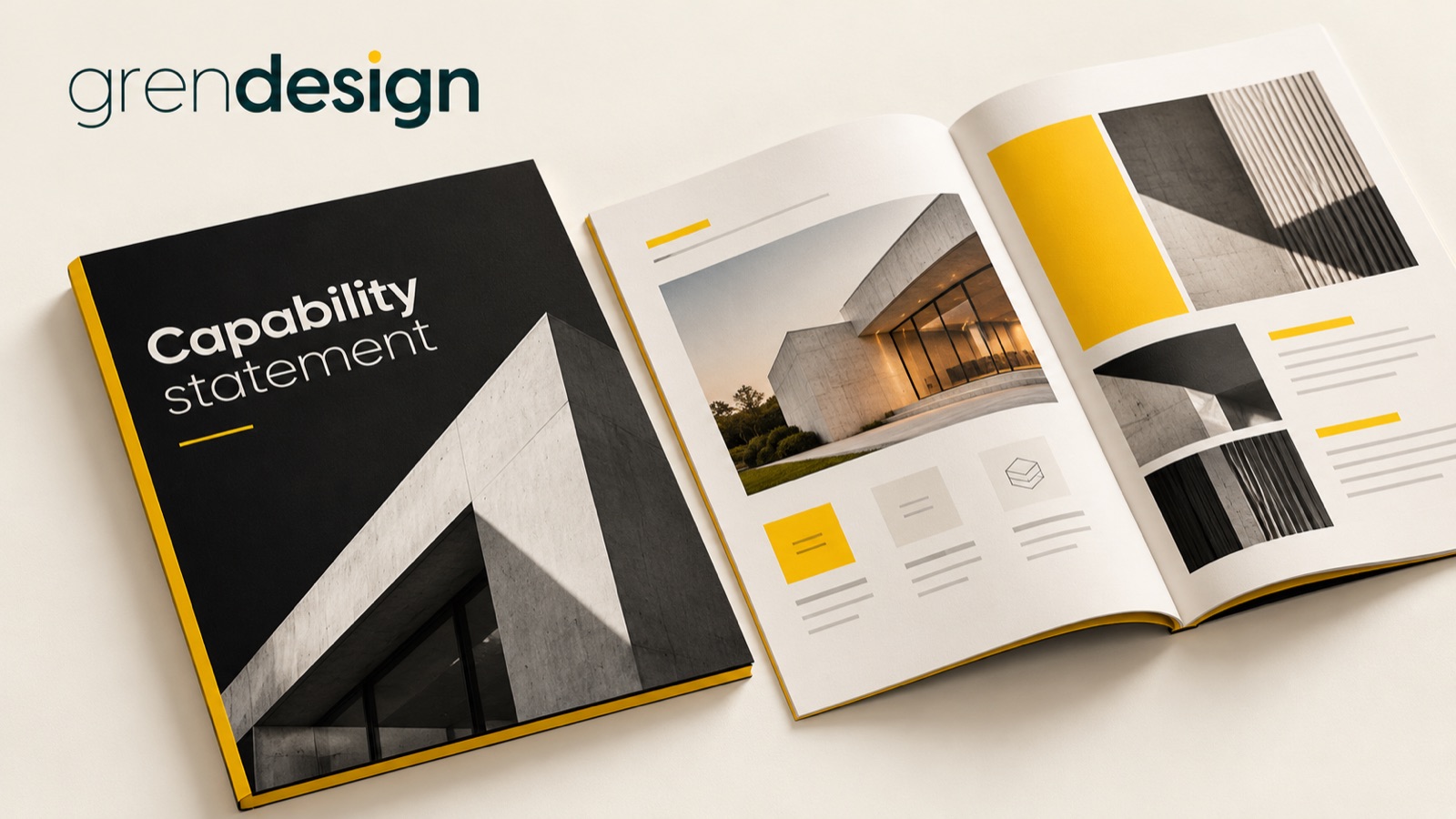
Prepare a capability statement buyers can use in a shortlist
A buyer should be able to use your capability statement to decide whether your business belongs in the next conversation. Make your relevant offer, supporting evidence and delivery boundaries easy to find before asking design to make the document memorable.
Put the advice into practice
Make your expertise look as considered as the work behind it
Bring brand, sales material and digital design into one coherent presentation.
Discuss your design briefChoose the decision the document needs to support
A capability statement sent after an introduction has a different job from a formal tender response. The first may help a buyer decide whether to request more detail. The second must answer the specific requirements and format of the procurement process.
Business Queensland’s capability-statement guidance describes the document as an account of what a business can deliver, used in settings such as pitches and tender submissions. It also recognises that the format can vary. There is no single page count that makes every statement useful.
Write a brief for the intended use before collecting content. Who will receive it? What are they considering? What should they be able to confirm? What is the next sensible step if your business is a fit?
For a general introduction, a concise overview may be enough. For a complex service, a short core document with relevant supporting material may work better than squeezing every detail into tiny type.
Organise the opening around buyer fit
The opening should make it easy to understand the work you do and where it applies. A broad claim such as “complete solutions for every industry” gives a buyer little basis for evaluating fit.
Try a practical description instead: the type of work, the customers or operating environments it suits, the geographical coverage and any important boundaries. Use accurate language your operations team would recognise.
In a hypothetical example, a maintenance contractor might describe planned mechanical maintenance for regional food-processing facilities, with the actual service area and delivery model clearly stated. That is more useful for shortlisting than a paragraph about being passionate and innovative.
Do not stretch the statement to make the business appear suitable for every opportunity. Clear limits help the right buyer ask better questions and reduce the chance of an unsuitable brief arriving later.
Build an evidence ledger before designing pages
Create a working list of the claims you want to make and the evidence behind each one. Keep this internal. The finished statement should show the useful evidence, not the drafting machinery.
- Claim: the specific capability you want the reader to understand.
- Evidence: a project, qualification, process or documented result that supports it.
- Scope: what the evidence does and does not establish.
- Permission: whether names, images, logos or results can be shared.
- Owner: the person who can confirm accuracy.
- Review trigger: when the information needs checking again.
This helps separate an established capability from an ambition. If your team plans to add a service next year, don’t present it as an existing delivery strength. If a project was delivered through a partnership, describe your actual role.
Use specific evidence where you have it. Where you do not, a careful description of the process is better than an invented performance figure.
Choose project examples for relevance
Your largest project is not automatically the most persuasive example for every buyer. Look for similarities in the work, constraints, operating environment or coordination required.
A compact project example can cover the brief, your responsibility, a meaningful challenge, the work delivered and an outcome you can substantiate. Keep those elements connected so the reader can see why the example belongs in this document.
As a hypothetical example, a buyer managing occupied premises may care about how a supplier coordinated access and staged work. A glamour photograph of a much larger empty-site project might answer fewer of their questions.
If results are confidential, consider an approved anonymised description that still explains the relevant experience. Do not imply client endorsement through a logo or quote unless you have permission to use it that way.
Make dates and context clear enough to interpret. A project completed by a previous employer is different from one delivered by the current company, even when the same person led the work.
Give design a clear information hierarchy
The designer needs to know which questions matter most, not just which colours to use. Mark the content a reader should see first, the evidence that supports it and the detail that can sit later.
Use descriptive headings that help a reader locate services, delivery approach and relevant experience. Avoid making every section a brand slogan. A buyer who needs a practical answer should not have to decode the language.
Let important evidence breathe. A project image can establish context, while a caption explains the work your business performed. An unlabelled image may look polished without helping the reader assess anything.
Check the document at the size it will actually be read. Small text, pale type and dense credential strips can become difficult on a laptop or printed copy. A layout that looks elegant at high zoom still needs to work in normal use.
Make operational details easy to verify
Include the contact who can take the next conversation forward, with a role and current business contact details. Explain how the buyer can request additional information without making them search the website.
Have the relevant internal owner check certifications, licences, insurance descriptions, service coverage and team information. Present credentials precisely rather than implying that one qualification covers every service or entity.
Keep sensitive or commercially confidential supporting documents out of a general public PDF unless their inclusion is appropriate and authorised. A statement can identify that supporting information is available through the buyer’s process without distributing everything to every recipient.
When the buyer supplies a template or asks for particular evidence, follow that request. A beautifully designed capability statement does not replace the required tender response or demonstrate compliance by itself.
Run a shortlist test before release
Give the draft to someone who knows the intended audience but did not write it. Ask them to answer: what work does this business do, why might it fit this requirement, what evidence supports that view and what would you ask next?
Then ask what feels unclear or overstated. If the reader remembers the photography but cannot describe the offer, revisit the hierarchy. If the promise sounds broader than the evidence, narrow the wording or supply stronger support.
Keep a controlled master and identify the owner responsible for updates. Different audience versions should remain consistent on core facts, with a version date that helps the team avoid sending an outdated file.
For a graphic design brief, bring the buyer context, approved content, evidence and intended formats together. That gives the design work a useful purpose: helping a capable buyer understand your business well enough to decide what happens next.
