


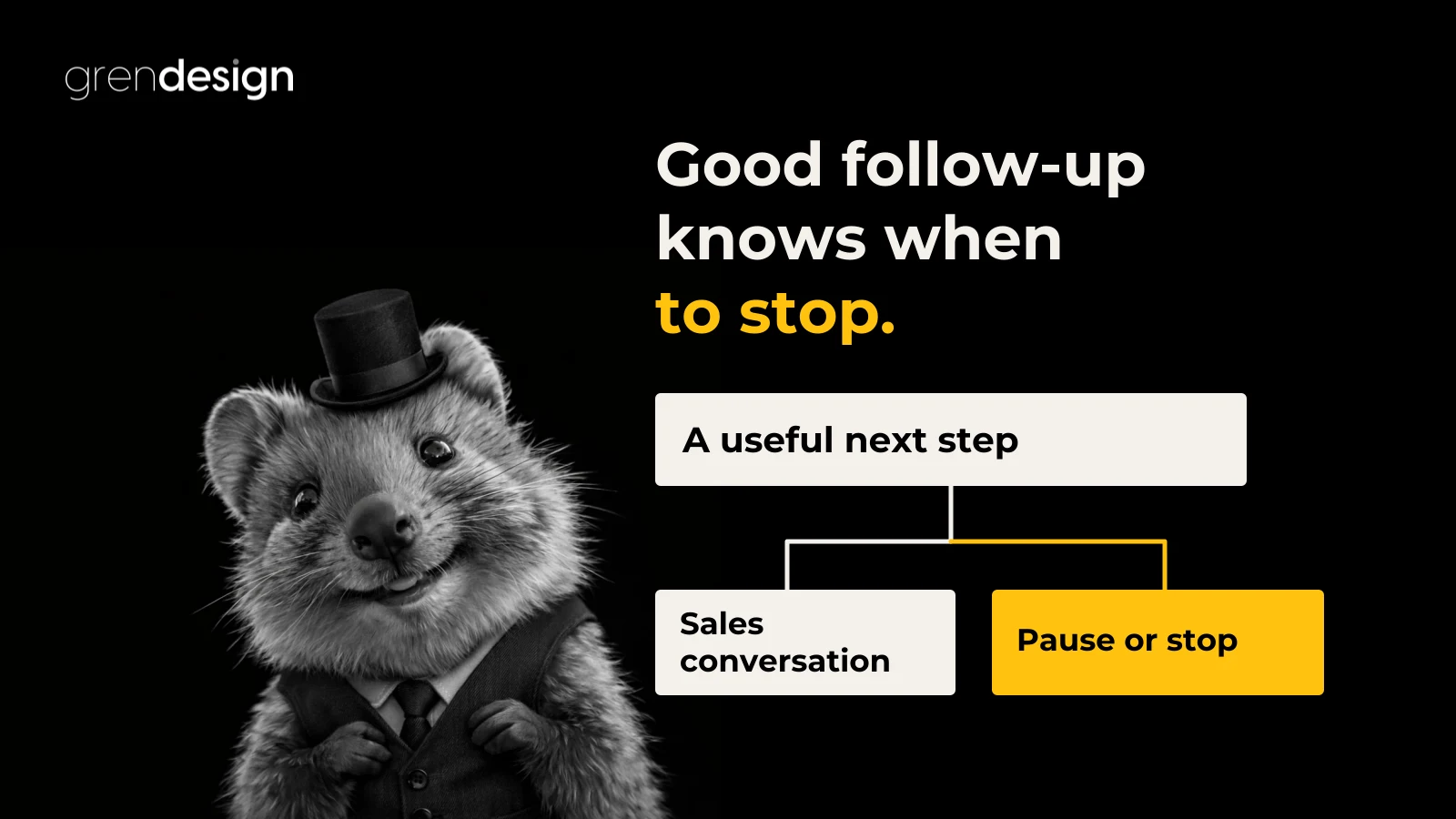
B2B lead nurturing: build a follow-up system that knows when to stop
A useful B2B lead nurturing strategy helps a suitable prospect take the next step without sending messages that no longer fit their situation. It needs clear entry criteria, useful content, a named owner and rules for handing over, pausing or stopping. The email sequence comes after those decisions.
Put the advice into practice
Give the first enquiry a useful follow-up
Plan campaigns, nurture and customer emails with clear triggers and review.
Plan your email programmeThat matters when the buying process takes time. Someone may need to discuss the project internally, compare approaches or wait for a budget decision. Helpful follow-up can support that work. But once they reply, book a meeting or become a customer, the original sequence may need to change immediately.
Start by mapping one journey your sales and marketing teams already understand. You can build a more reliable system around a specific situation than around a general instruction to “nurture all our leads”.
Separate active sales conversations from educational nurture
People can share a job title or industry and still need very different communication. Start with their relationship to the business and their current buying situation.
| Situation | Useful next step | What to avoid |
|---|---|---|
| Active enquiry or sales conversation | A named person responds to the actual question and agrees the next action | A generic introduction arriving while someone waits for a quote |
| Permission-based educational nurture | Relevant guidance that helps the prospect assess the problem or prepare a decision | Treating every interaction as a request for a sales call |
| Existing customer | Communication appropriate to their service and relationship | Continuing to sell the service they’ve just purchased |
| Inactive or uncertain record | Review relevance, permission and data quality before any further marketing | Automatically restarting an old sequence because the contact still exists |
These categories aren’t permanent labels. A person can move from research into an active project, or tell you that plans have changed. Your system needs to reflect that change before the next message is sent.
Define who enters and why they should hear from you
Choose a narrow starting point. For example: people who requested a planning resource, agreed to related follow-up and aren’t already in an active sales conversation. This gives the content a purpose and makes the entry conditions testable.
A resource download alone isn’t a reliable declaration of purchase intent. A quote request also shouldn’t be treated as blanket consent for unrelated campaigns. Record what the person requested, the permission basis and the information you genuinely need to follow up appropriately.
For commercial email in Australia, ACMA’s spam guidance requires consent, accurate sender identification and an easy unsubscribe method. Requests to unsubscribe must be honoured within five working days. Keep evidence of consent and check that your process meets the requirements; this brief summary isn’t legal advice.
Make the operational check more specific than “subscribed equals yes”. Can the team see how permission was obtained and what kind of communication it covers? Is the person already suppressed in another connected system? If the answer is unclear, hold the record for review rather than assuming eligibility.
Collect only what helps the journey. A service interest and stated timing may be enough to choose relevant content. A long form asking for information you won’t use creates more work without making the follow-up more thoughtful.
Map a sequence around the prospect’s decision
The following is an illustrative workflow for a business selling a complex service. It isn’t a client case study or a recommended sending schedule. Timing should reflect what the person agreed to receive and how the buying decision works.
- Deliver the requested resource. Make it easy to access and explain what it helps them do. Check whether the resource-delivery message and any later marketing have the appropriate basis.
- Explain a practical choice. Help them distinguish two approaches, understand a dependency or avoid a scope misunderstanding. The message should be useful even if they don’t enquire.
- Offer relevant evidence. Use an approved case study, demonstration or process explanation that fits the service interest. Don’t imply a result you can’t substantiate.
- Provide a decision aid. A briefing checklist, requirements worksheet or comparison guide can help the person involve colleagues and prepare a clearer project.
- Invite an appropriate next step. Offer a discussion when useful, without presenting silence as a problem the prospect needs to solve.
Before each step, check that the person remains eligible. A delay between emails isn’t a substitute for this check. Someone may have replied to a salesperson, booked through a different calendar or become a customer since the previous step.
A good content test is: “What can the reader decide or do after this?” If the answer is only “remember our business exists”, the message may need a more useful purpose or may not need to be sent.
Give sales context, a next action and an owner
A sales handoff should make it possible for someone to act without reconstructing the whole journey. A numeric lead score can help organise attention, but it doesn’t explain what the person needs.
Separate fit from behaviour. Fit concerns whether the business can help: relevant service, location, requirements and any known constraints. Behaviour concerns what the prospect has done or asked for. An email open by itself doesn’t establish either suitability or readiness to buy.
For a handoff, include:
- The person’s stated need and the source of that information.
- The resource or service they requested, with relevant communication history.
- The signal that triggered the handoff, such as an explicit question or meeting request.
- What is known about fit and timing, with unknowns left clearly marked.
- A named sales owner, a next action and an agreed response expectation.
- The current nurture status, so sales knows whether other messages are paused.
For example, “Requested a discussion about replacing the current reporting process before the next planning cycle” gives a salesperson a useful opening. “High score, clicked three times” leaves them guessing.
Close the loop after handoff. Sales should be able to accept the lead, return it with a reason or mark it unsuitable. If nobody accepts ownership, send the exception to a named backup. A notification in a shared inbox isn’t the same as a person taking responsibility.
Write the stop and suppression rules before launch
Use separate outcomes for a temporary pause, an exit from this journey and a marketing suppression. They mean different things. A meeting can pause an educational sequence; an unsubscribe needs to stop marketing within the applicable scope, not merely skip the next email.
| Signal | Workflow action | Human responsibility |
|---|---|---|
| A reply arrives | Pause the sequence pending review | Assigned owner reads it, responds where appropriate and sets the next status |
| A meeting is booked | Pause generic nurture and route to the sales owner | Confirm the meeting context and avoid conflicting follow-up |
| An opportunity becomes active | Exit the general sequence unless a specific continuation is appropriate | Sales owns the agreed next action |
| The person becomes a customer | Exit acquisition nurture | Move to the relevant customer process without assuming new marketing permission |
| An unsubscribe or complaint is received | Suppress the relevant marketing and propagate the change across connected sending systems | Check the request is honoured and isn’t undone by another import |
| The address fails or the contact is unsuitable | Stop or hold the journey as appropriate to the reason | Review data quality or fit; don’t repeatedly re-enrol |
| The sequence ends without a response | End this journey without automatic looping | Review any future contact against relevance and permission |
Don’t assume the software already handles every rule. Check what counts as a reply, how meetings are detected and whether updates sync between systems. An automated out-of-office response may need a different review from a genuine buying question. A meeting cancelled later shouldn’t automatically restart promotional messages without an agreed rule.
Test with internal records before enrolling prospects. Include a reply, an unsubscribe, a meeting booking, a conversion and a contact imported twice. Also test an event that arrives shortly before a scheduled message. Confirm what is cancelled, what remains queued and who sees an exception.
AI may help summarise relevant context or suggest a next action within an approved process. Keep a person accountable for consequential decisions and ambiguous replies. The important improvement is a reliable handoff, not simply a larger amount of automated activity.
Measure progress without rewarding unwanted activity
Choose measures that reflect the journey’s purpose. Useful reporting can include meaningful replies, accepted handoffs, meetings, qualified opportunities and won work where the connection is tracked reliably. Also review opt-outs, complaints, delivery failures and contacts stuck without an owner.
Keep the denominator clear. “Four accepted handoffs from 40 eligible contacts who entered this journey” is more informative than “four conversions” without a definition. Compare groups that have had enough time to progress through the buying cycle.
Look at the reasons behind outcomes. If people reply with questions the sequence never addresses, improve the content. If suitable leads are handed over but nobody responds, fix ownership. If a message generates repeated opt-outs, check its relevance, expectations and timing before increasing volume.
Don’t count every sale that touched an email as revenue caused by the sequence. Where several channels and sales conversations contributed, describe the measurement honestly. The aim is to improve the decision process, not give one system all the credit.
Bring this workflow brief to your next sales and marketing meeting
Complete the fields below before selecting new software or writing a full sequence. If an answer is missing, that is a useful implementation task rather than a reason to guess.
| Field | Your agreed answer |
|---|---|
| Journey and intended outcome | Which buying situation are we supporting? |
| Entry trigger | What specific event starts the journey? |
| Eligibility and permission | Who qualifies, what evidence is required and who is excluded? |
| Useful content | What decision will each message help the reader make? |
| Timing | What spacing fits the expectation and buying process? |
| Owner and backup | Who monitors the journey and handles exceptions? |
| Sales handoff | Which signal triggers it, what context is sent and who accepts it? |
| Pause, exit and suppression | What stops messages, and how is that checked before sending? |
| Re-entry | Under what conditions, if any, can someone enter again? |
| Testing and review | Which scenarios must pass, what will be measured and when will we review? |
Frequently asked questions
How many emails should a B2B nurture sequence contain?
Use as many as are needed to support the agreed journey, with a clear end. Each message needs a distinct purpose. A fixed number is less important than relevance, permission and responding to changed circumstances.
Should a reply automatically stop the sequence?
A practical default is to pause for review so generic messages don’t conflict with the conversation. Define how genuine replies, automated responses and unrelated messages are handled in your particular system.
Can we use email opens to qualify leads?
Don’t use an open alone as qualification. Combine relevant fit information with meaningful actions or an explicit request, and give sales the context behind the signal.
Do we need a new platform to improve follow-up?
Not necessarily. First identify what the current process cannot do reliably. Clear ownership, better content and tested stop rules may solve problems that another subscription would simply carry forward.
Start with one journey you can improve
Choose an existing follow-up process and map where people enter, what helps them decide and when sales should take over. Grendesign’s email marketing and automation services provide a starting point for discussing that work. Bring the workflow, the gaps and the systems already in place, so any proposed solution addresses a real need.
