


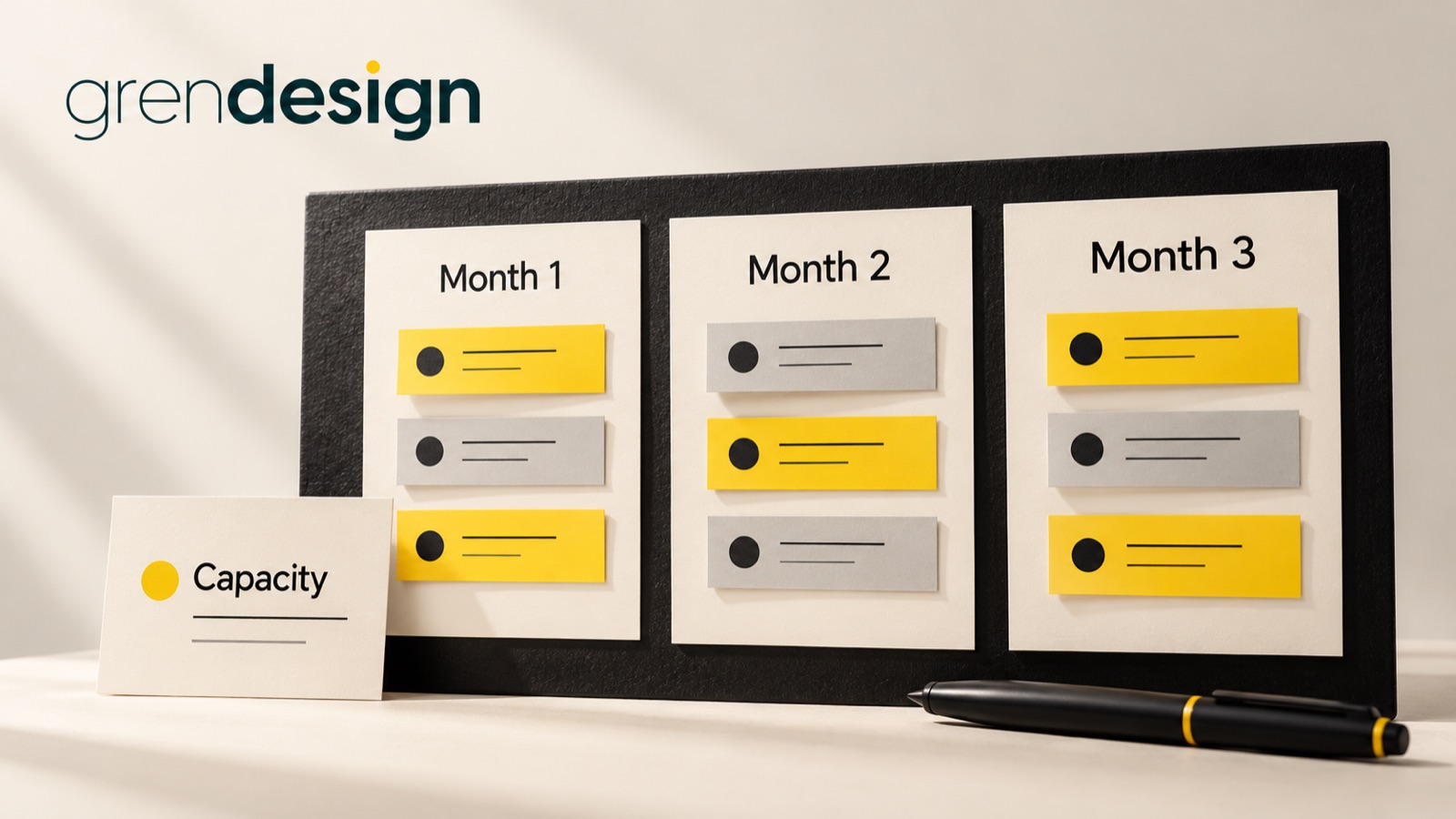
Build a quarterly marketing plan around capacity and customer demand
A quarterly marketing plan should connect the work your business needs with the work your team can realistically deliver. Start with customer demand, sales priorities and available capacity. Choose the channels and content after those decisions are clear.
Put the advice into practice
Turn scattered marketing into a considered plan
Connect strategy, creative, channels and ongoing review around your sales process.
Explore our marketing services
Discuss an ongoing marketing partnershipName the business decision the quarter needs to support
“Do more marketing” leaves almost every activity looking reasonable. A more useful starting point is a specific commercial need: improve the mix of enquiries for a particular service, help existing customers understand an additional capability, or support a new offer that is ready to deliver.
Check the need with the people responsible for sales and delivery. More demand is not always the immediate constraint. The business may need clearer qualification, better proposal support or a more consistent explanation of what is included.
Choose a small number of priorities and write down what sits outside the quarter. That exclusion list protects the plan when an attractive but unrelated idea appears. It also makes trade-offs visible to people who are not involved in daily marketing work.
The Australian Government’s marketing plan guidance covers the broader foundations of objectives, customers, activities and budget. A quarterly plan translates those foundations into a workable next period, rather than replacing the business strategy.
Look for demand in conversations as well as reports
Review recent enquiries, lost opportunities, existing customer requests and sales objections. Ask which problems buyers are trying to solve and where they hesitate. Website and campaign data can help, but a report alone may not explain why someone did not proceed.
Group the evidence by service and buying situation. Separate a repeated concern from one unusual request. Record the source and how confident you are, especially when the sample is small.
Useful planning questions include:
- Which services are customers already asking about?
- Where do suitable prospects need more explanation before taking the next step?
- Which objections reflect missing information, and which reflect a genuine mismatch?
- What work can the delivery team accept during this quarter?
- Are there known buying windows, events or customer planning cycles?
A seasonal assumption should be checked against your own history and current conversations. A general calendar can suggest a prompt, but it cannot tell you that your customers are ready to buy.
Count approval and follow-up time, not just production
A content calendar can look achievable until it includes interviews, technical review, design, revisions and distribution. Estimate the full path for each important deliverable, including the time needed from busy subject-matter experts.
List the people available and the work they already own. Then note planned leave, launches and other deadlines. Leave room for maintenance and genuinely time-sensitive updates instead of allocating every hour to new campaigns.
Sales capacity belongs in the plan too. If a campaign invites consultations, who will respond, qualify enquiries and attend the meetings? If a new offer depends on delivery staff, are they available when the campaign runs?
Use capacity as a design constraint rather than a reason to abandon useful work. One strong service-page improvement supported by a short email and several practical posts may be more manageable than launching five unrelated campaigns.
Build a small, connected programme
Give each initiative an audience, a question it answers, a desired next step and an owner. Then choose the assets and channels that support that path. This prevents a list of disconnected posts from standing in for a plan.
For example, an illustrative professional services business wants better-qualified enquiries for a specialist project service. Its quarter might include a clearer service page, an approved project example, a short sales checklist and a sequence of organic posts explaining common scope decisions.
The page helps buyers understand the offer. The project example provides relevant evidence. The checklist supports a sales conversation. The posts introduce the questions and point to deeper information where useful. The pieces have different jobs, even though they support one priority.
This is a fictional planning example, not a Grendesign result. A different business may need an event, a referral programme or customer communication instead. Select the programme because it fits the buying situation, not because a particular format is fashionable.
Schedule around dependencies and decisions
Work backwards from when the business needs the material. If a case study requires customer approval, that approval is a dependency with uncertain timing. Do not schedule its promotion as though the finished asset already exists.
Use a simple sequence: gather evidence, make the core asset, approve it, adapt it, distribute it and review the response. Some steps can overlap, but the dependency should be clear.
For each initiative, record:
- The owner and final approver.
- The source material or access required.
- The planned effort and authorised budget.
- The first usable deliverable.
- The launch or distribution window.
- The measure that will inform the next decision.
- The condition that would delay, narrow or stop the work.
Separate committed work from experiments and optional ideas. When something new is added, identify what moves or what extra capacity is genuinely available. A plan that only grows soon stops being a useful agreement.
Choose measures that can change what you do
Connect measures to the initiative’s purpose. If you are clarifying a service, review the relevance of incoming enquiries and repeated sales questions alongside page activity. If you are supporting proposals, ask whether the material is being used and what buyers still need.
Agree definitions before reporting. An enquiry is not necessarily a qualified opportunity, and an opportunity is not a sale. Keep those stages separate so a rise in activity does not automatically become a claim of business growth.
Choose a baseline and a review date that suit the buying cycle. A long-consideration service may not produce closed sales within the quarter, but you can still inspect leading evidence without pretending it proves future revenue.
Use the review to make a decision: continue, adjust the audience or message, fix a bottleneck, or stop an activity that no longer fits. Avoid collecting metrics merely because a platform makes them easy to export.
Keep the plan useful after the first meeting
Hold a brief regular delivery check and a more considered results review at agreed points. The delivery check asks what is blocked and what changed. The results review asks what the work is teaching you about customers and the business priority.
Carry forward unfinished work only after checking whether it still matters. A task should not survive into the next quarter simply because it has a row in a spreadsheet.
Your final plan can be short: a clear objective, a few connected initiatives, real owners, capacity assumptions and decision points. The value lies in the choices it makes visible.
If you need an outside perspective on those choices, explore Grendesign’s B2B marketing services. Bring the customer questions, sales priorities and delivery constraints so the conversation starts with the work the business actually needs.
